A cryo-electron microscopy reconstruction of a virus particle

Cryo-EM workstations for cryoSPARC and RELION

cryoSPARC and RELION turn terabytes of microscope movies into 3D structures, with the heavy steps running on NVIDIA GPUs under Linux. We size each machine per GPU, giving every card the processor cores, memory and fast SSD cache cryoSPARC recommends.

Chat with our team

Recommended configurations

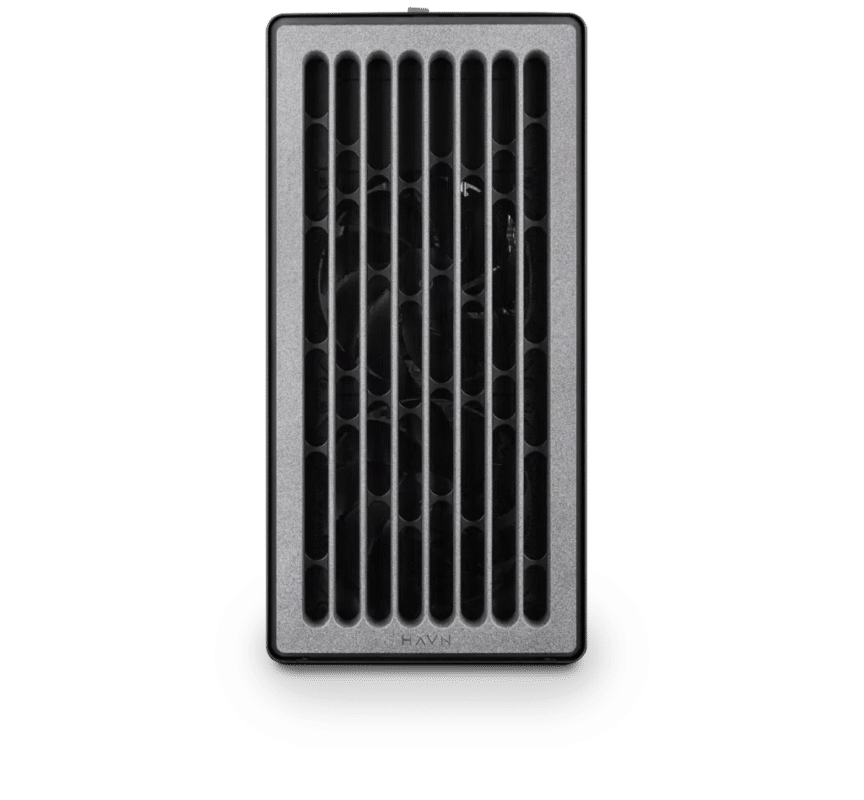
Front on view of Renderboxes Electron Early 2026 Workstation
Standard

cryoSPARC and RELION – Standard

Electron · NVIDIA RTX PRO 5000 48GB

One user processing one dataset at a time, with a 48GB card for large boxes and RELION's two processes per GPU.¹

  • CPU: AMD Ryzen 9 9950X3D
  • RAM: 128GB DDR5 5600MT/s (2x64GB)
  • PCIe 1 (x16): NVIDIA RTX PRO 5000 Blackwell 48GB
  • NVMe Storage (Gen 5.0): M.2 NVMe Gen 5 4TB
  • NVMe Storage (Gen 5.0): M.2 NVMe Gen 5 2TB
  • Operating System: RBOS Rocky 9

£15,255 inc VAT

Built to order · build time 5–7 working days1

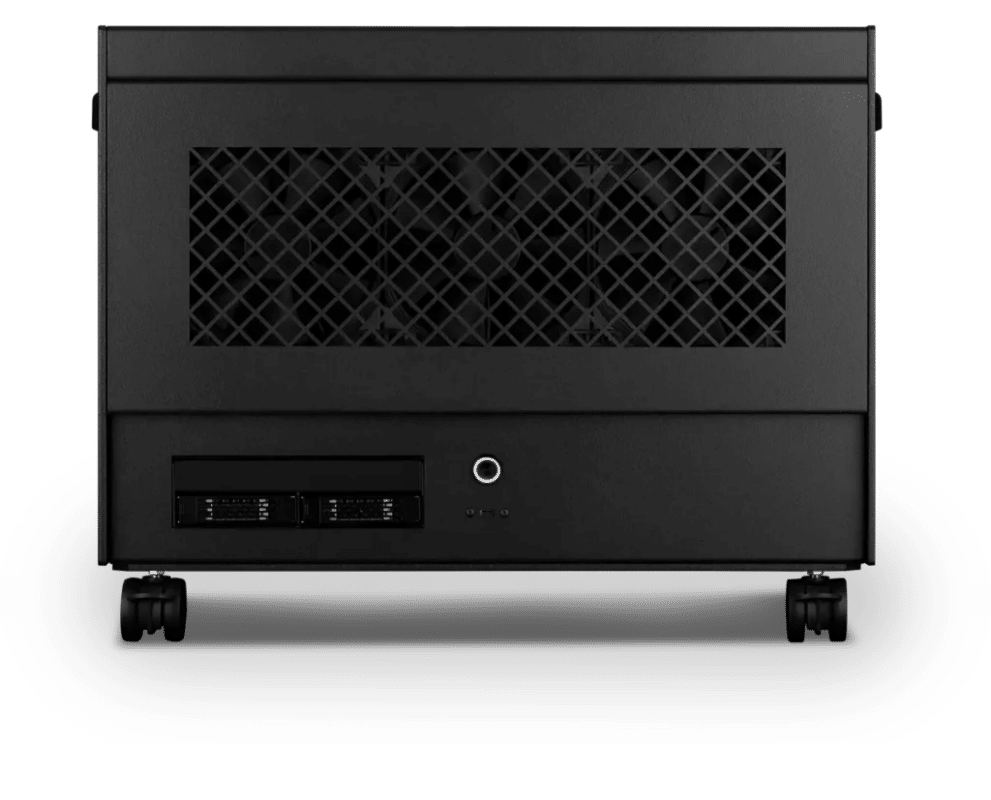
Front on view of Renderboxes Atom Workstation
Heavy

cryoSPARC and RELION – Heavy

Atom · 2× NVIDIA RTX PRO 5000 48GB

A small group: two jobs at once, or multi-GPU motion correction and 2D classification. Twice the GPUs of Standard.²

  • Motherboard: Gigabyte TRX50 AI TOP (4 × PCIe slots, 10GbE)
  • CPU: AMD Ryzen Threadripper 9960X 24 Core
  • RAM: 4 × 64GB RDIMM ECC DDR5 6400
  • PCIe slots (16x): 2 × NVIDIA RTX PRO 5000 Blackwell 48GB
  • NVMe M.2 Drives (Gen 5): 2 × M.2 NVMe Gen 5 4TB
  • Operating System: RBOS Rocky 9

£36,125 inc VAT

Built to order · build time 7–10 working days1

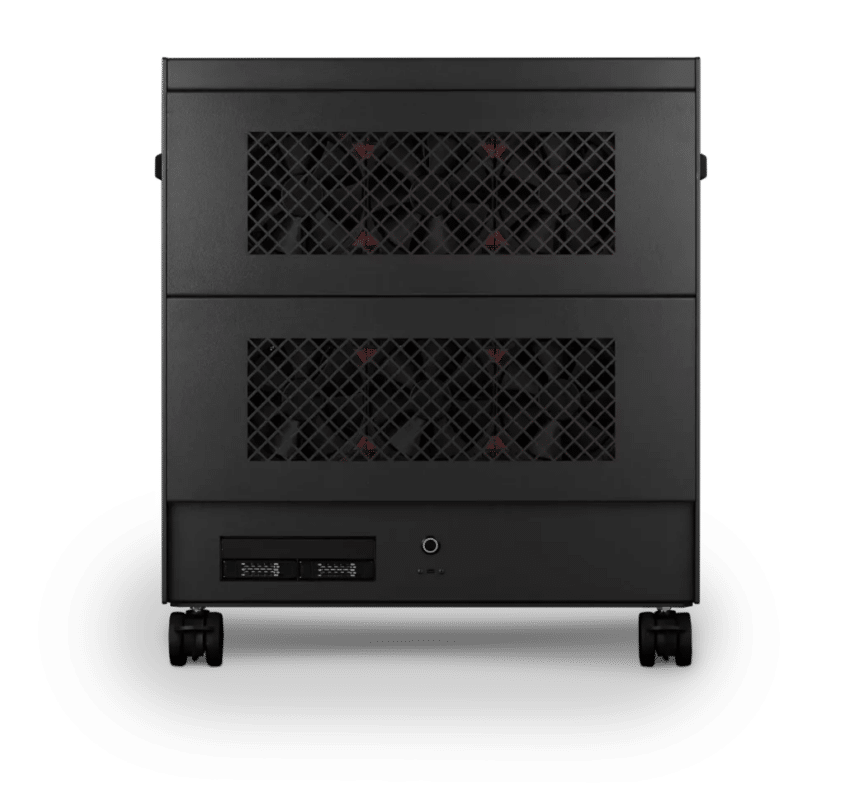
Front on view of Renderboxes Nano Pro 4 GPUs in one workstation
Studio

cryoSPARC and RELION – Studio

Nano Pro · 4× NVIDIA RTX PRO 6000 Max-Q 96GB

A lab's main processing machine, built around cryoSPARC's four-GPU reference specification with 96GB per card.¹ ²

  • Motherboard: ASUS Pro WS WRX90E-SAGE SE (7 × PCIe slots, IPMI, 10GbE)
  • CPU: AMD Ryzen Threadripper PRO 9975WX 32 Core
  • RAM: 8 × 64GB RDIMM ECC DDR5 6400
  • GPU options: 4 × NVIDIA RTX PRO 6000 Blackwell Max-Q 96GB
  • NVMe M.2 Drives (Gen 5): 2 × M.2 NVMe Gen 5 4TB
  • Operating System: RBOS Rocky 9

£103,395 inc VAT

Built to order · build time about 10–13 working days1

Front view of the Molecule Air Workstation 8 GPUs, built for labs
Team

cryoSPARC and RELION – Team

Molecule Air · 8× NVIDIA RTX PRO 6000 Max-Q 96GB

Facility-scale processing and cryoSPARC Live alongside batch jobs on eight 96GB cards. Pair with fast shared storage.²

  • CPU: AMD EPYC 9375F 32 Core
  • RAM: 24 × 32GB RDIMM ECC DDR5 6400
  • GPU options: 8 × NVIDIA RTX PRO 6000 Blackwell Max-Q 96GB
  • NVMe Storage: M.2 NVMe Gen 4 1TB
  • Operating System: RBOS Rocky 9

£193,945 inc VAT

Built to order · build time 14–21 working days1

Each recommended system is a starting point. Select Customise to add components or change the specification before you order.

1 Working days, when all parts are in stock. If a part is delayed, we confirm your dispatch date before your order goes ahead.

What are cryoSPARC and RELION? logo

What are cryoSPARC and RELION?

Cryo-electron microscopy images frozen samples of proteins and other molecules. Each image is noisy, so single-particle analysis finds the individual particles across thousands of micrographs, sorts them by view and averages them into a 3D map, often at near-atomic resolution.

cryoSPARC, from Structura Biotechnology, is a high-performance processing system with a browser-based interface that covers the path from movies to a refined map. Its algorithms include Non-Uniform Refinement, and cryoSPARC Live processes and assesses data in real time while the microscope is still collecting. It is free for non-profit academic research, with licences for commercial users.

RELION, developed in Sjors Scheres' group at the MRC Laboratory of Molecular Biology, is free, open-source software that uses an empirical Bayesian approach. Version 5 adds Blush regularisation, DynaMight, automated model building with ModelAngelo and a new subtomogram averaging pipeline. cryoSPARC can import particles with RELION .star metadata.

cryoSPARC is a trademark of Structura Biotechnology Inc. RELION is developed at the MRC Laboratory of Molecular Biology. Renderboxes is not affiliated with or endorsed by either.

Why structural biology labs choose them

  1. Built for GPUs

    cryoSPARC's motion correction, CTF estimation, classification and refinement run on NVIDIA GPUs, and RELION accelerates classification and refinement on the GPU.

  2. Movies to map in one place

    Both cover import, motion correction, CTF, picking, classification and refinement in one interface.

  3. Academic access

    RELION is open source and cryoSPARC is free for non-profit academic research, so academic labs pay no software licence fee.

Diagram: Import movies, then Motion correct, then CTF estimate, then Pick and extract, then 2D classify, then 3D refine

How a single-particle cryo-EM job runs

The standard path from microscope movies to a 3D map. Almost every stage after import runs on the GPU in cryoSPARC.

  1. Import

    Movies and gain references are read from shared storage. Fast sustained sequential reads keep the GPUs busy from the start.

  2. Motion correction

    Each movie's frames are aligned to undo beam-induced motion. cryoSPARC runs this on one or more GPUs; RELION uses its own processor implementation or a wrapper to the GPU-based MotionCor2.

  3. CTF estimation

    The microscope's defocus and optics are measured for every micrograph so they can be corrected later.

  4. Particle picking

    Blob, template or Topaz neural-network pickers find the particles, which are then cut out into stacks.

  5. 2D classification

    Particles are sorted into views and averaged, and the poor ones are discarded. cryoSPARC's particle algorithms make multiple passes through the data, which is why an SSD cache matters.

  6. 3D reconstruction and refinement

    An initial model is built and refined to high resolution. The box size and the GPU memory decide how large a particle you can refine.

What each part of the machine does for cryo-EM

GPU memory

Sets the largest box size you can refine and whether RELION can run two processes per GPU.

cryoSPARC needs at least 11GB per GPU, notes that Patch Motion Correction can run out of memory on cards under 16GB, and says a 12GB card typically handles a 700-pixel box. It names memory bandwidth as the most important GPU metric.¹

Matters most

Number of GPUs

Patch Motion Correction, Patch CTF Estimation, 2D classification and extraction can run across several GPUs, and a job can be queued on a specific GPU.

More GPUs let a lab split one job over several cards or let several users work at once.

Matters a lot

Fast SSD cache and storage

cryoSPARC caches particle stacks on a local SSD, because its particle algorithms make multiple passes through the data.

It recommends a 2TB PCIe SSD cache per worker, and sustained sequential reads of 1,000MB/s from storage to keep four GPUs busy in pre-processing.¹

Matters a lot

System memory

Holds particle data and job state alongside each GPU.

cryoSPARC recommends 64GB per GPU and at least 100GB/s of memory bandwidth, which it says is especially important for cryoSPARC Live pre-processing.¹

Matters

Processor

Runs import, RELION's processor-based steps and the cryoSPARC master process.

cryoSPARC recommends four cores per GPU, and says a faster clock rate is more advantageous than a higher core count.¹

Matters

What labs use it for

Protein structures

Solve structures of enzymes, receptors and complexes that will not crystallise.

Processing in-house means no queue for shared facility compute.

Membrane proteins

Transporters, channels and receptors in detergent or nanodiscs.

RELION's Blush regularisation helps most when the signal is weak.

Drug discovery

See where a compound binds and how the protein responds.

Each ligand is another dataset, so throughput matters. Structura describes cryoSPARC as built for drug discovery and research.

Live processing

cryoSPARC Live processes and assesses movies as they arrive from the microscope.

You can judge sample quality during the session and change course early.

Flexibility and heterogeneity

3D Variability and 3D Flex in cryoSPARC, and DynaMight in RELION, reveal how molecules move.

They model continuous structural change rather than a few discrete states.

Tomography

Subtomogram averaging of molecules inside cells with RELION 5's new pipeline.

The pipeline starts from raw tilt-series movies and can end with automated model building.

Which jobs use the GPU in each package

Both packages cover the same stages, but not always on the same hardware.³ 1. cryoSPARC hardware guidance as published by Structura Biotechnology; actual needs depend on box size, dataset size and job type. 2. Comparisons are of the number of GPUs between Renderboxes builds, not speed. 3. Based on cryoSPARC and RELION documentation in November 2026; job options change between versions.

cryoSPARC RELION 5
Motion correction Patch Motion Correction on GPU, multi-GPU Own processor implementation, or a wrapper to GPU-based MotionCor2
CTF estimation Patch CTF Estimation on GPU, multi-GPU Wraps CTFFIND 4.1 on the processor
Particle picking Blob and Template pickers on one GPU; Topaz wrapper Laplacian-of-Gaussian, template matching or Topaz
2D classification GPU, multi-GPU GPU; one process can use several GPUs
3D refinement Homogeneous and Non-Uniform Refinement on GPU 3D auto-refine on GPU, with optional Blush
Licence Free for non-profit academic research; commercial licence Free and open source (GPL)

Tell us what you need for cryoSPARC and RELION

Share your cryoSPARC and RELION versions, typical dataset and box sizes, your storage and network setup, and how many jobs you run at once. We will review the right configuration and confirm availability before you order.

This field is for validation purposes and should be left unchanged.

Frequently asked questions

No. cryoSPARC almost exclusively uses single-precision operations on the GPU, and RELION's documentation says its double-precision GPU option slows processing considerably without improving resolution. cryoSPARC names GPU memory bandwidth as the most important GPU metric.

cryoSPARC asks for at least 1TB of local SSD and recommends 2TB per worker; its four-GPU example machine has a 4TB cache. Larger particle stacks and several projects at once need more, so we size the cache to your datasets.

Yes. Both run on Linux with NVIDIA GPUs, and cryoSPARC can import particle stacks with RELION .star metadata. Assign GPUs per job so the two do not compete for the same card.

Keep raw movies on shared storage that every node can reach. cryoSPARC requires sustained sequential reads of 1,000MB/s to keep four GPUs busy in pre-processing and recommends a 10Gbps link to storage, so the network often matters as much as the workstation.

No. cryoSPARC is Linux only, with Ubuntu 22.04 and 24.04 and Rocky Linux 8, 9 and 10 recommended (cryoSPARC guide), and RELION's installation guide covers Linux distributions such as Ubuntu and RHEL (RELION documentation). These machines ship with Rocky Linux 9.

cryoSPARC supports NVIDIA only (cryoSPARC guide). RELION 5 added HIP/ROCm support so relion_refine can run on AMD GPUs (RELION documentation). We supply NVIDIA cards for both.

cryoSPARC needs at least 11GB, and Patch Motion Correction can run out of memory on cards under 16GB (cryoSPARC guide). RELION can run more than one MPI process on each GPU (RELION documentation), which needs more memory per card. Our configurations start at 48GB per card.

Some do. Patch Motion Correction, Patch CTF Estimation, 2D Classification and the GPU Extract job can run across several GPUs, while Blob and Template Picker use one (cryoSPARC guide). You can also queue a job on a specific GPU, so several jobs can run at once on separate cards.

Standard suits one user processing on a single GPU. Heavy suits a small group, with two 48GB cards. Studio matches cryoSPARC’s four-GPU reference build with headroom. Team is for large labs with fast shared storage and 10Gbps or faster networking.

Talk to someone at Renderboxes

Not sure which build is right? Speak to our team and we will help you choose the right configuration for your work.

Phone icon

Request a callback

Book a time that suits you and one of our team will call you.

BOOK A CALL
Mail icon

Send us an enquiry

Tell us what you are working on and we will recommend a configuration.

Contact us
Fast response team icon

Customer care phone

Call us for instant support

0800-955-RNDR (7637)

Mon-Fri, 9 AM - 5 PM