






SHIP US YOUR RAM
SUYR - SHIP US YOUR RAM
Why your DDR5 quote just doubled — and what we’re doing about it
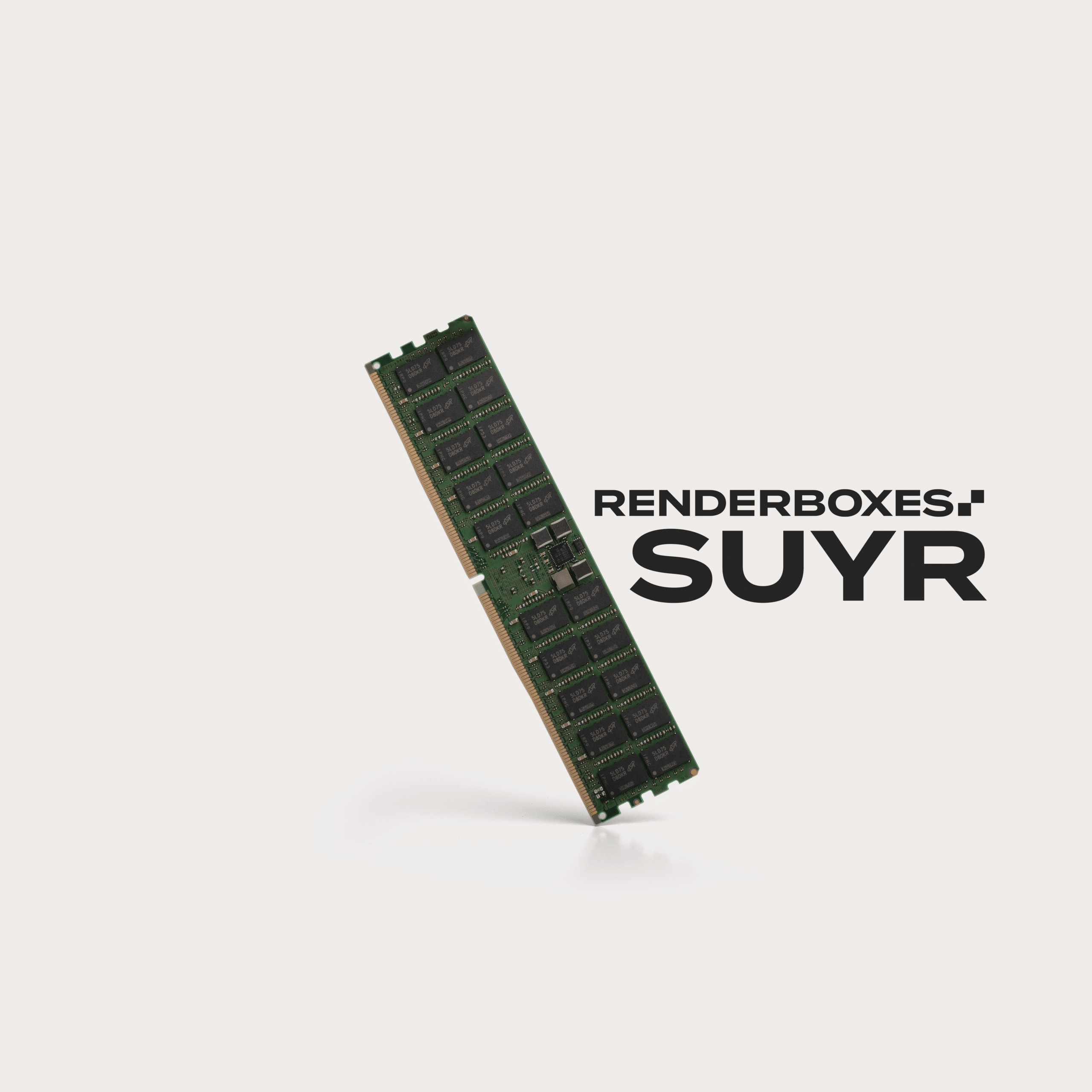
Introducing SUYR (Ship Us Your RAM): bring your own compatible DDR5 to your new Renderboxes build, and we’ll test, validate and integrate it as part of the standard build process.
The number on the quote is not a typo
If you’ve asked us for a workstation quote recently and the RAM line made you blink, you are not alone. In the last four months, some of the DDR5 categories we buy have gone up by more than 100%. Not ten percent. Not twenty. Double, in some cases, and still climbing.
I’ve been building workstations for a long time. I’ve seen memory prices cycle up and down. This one is different, and it’s worth explaining why — because if you understand what’s driving it, you’ll understand why our response is what it is.
AI is eating the world’s RAM
The short version: the hyperscalers — the handful of companies building the infrastructure behind modern AI — are consuming DDR5 at a scale that has never happened before in the history of memory. They are not price-sensitive. They are not waiting for better deals. They are buying everything the fabs can produce, at whatever the fabs want to charge, and they’re doing it on multi-year commitments.
Everything else in the DDR5 market — workstations, servers, enthusiast PCs, your laptop — is competing for what’s left. Supply is tight. Demand is record-breaking. Prices reflect that.
And the part nobody wants to say out loud: this isn’t a short squeeze that resolves next quarter. Based on the capacity commitments already in place, the pressure is going to continue through 2026 and into 2027. Plan accordingly.
Why workstations feel it first
Workstation builds don’t use the cheapest memory on the shelf. They use specialist, high-capacity, often ECC DDR5 — the kind of modules with strict validation requirements that have to pass motherboard QVL testing, run reliably at full speed for 24/7 duty cycles, and survive the thermal pressure of a fully-loaded render node.
That’s exactly the category the hyperscalers are also buying. So we feel it fast, and we feel it hard. And we can’t magic it away — we can’t buy RAM for less than our suppliers sell it to us. There’s no secret stockpile.
What we can do is stop insisting that every module in your new machine has to come from us.
Ship Us Your RAM (SUYR…)
Here’s the offer. If you’re buying a new Renderboxes workstation and you already own compatible DDR5 modules, send them to us. We’ll test them on our bench, validate them against your new motherboard, and integrate them into your build exactly the way we’d integrate modules we bought ourselves. You keep the money you would have spent on RAM. We do the labour of making sure it actually works.
The reason this is practical on our platforms — and the reason it’s unusual in the industry — is a piece of AMD platform continuity that doesn’t get enough credit.
AMD’s Threadripper platform has kept the same DDR5 generation across multiple workstation revisions. If you bought a Renderboxes on the previous-generation Threadripper (TRX40) or Threadripper Pro (WRX80) platform, your ECC DDR5 is physically and electrically compatible with our current TRX50 and WRX90 machines. On the EPYC side — which is what our Molecule Air is built on — Genoa onwards is the same story. That’s multiple CPU generations of RAM compatibility. Most customers and, frankly, most integrators don’t realise this.
So there are two obvious scenarios where SUYR saves you real money:
One. You’re upgrading from a previous-generation Renderboxes (or a comparable workstation from another builder). Your CPU is due an upgrade, your GPU is due an upgrade, but your RAM is perfectly good. Rather than pay today’s DDR5 prices on top of everything else, ship us the modules from your current machine and we’ll put them in your new one.
Two. You have spare RAM sitting in a drawer, left over from a previous build or a decommissioned system. Same deal. Send it in, we’ll validate it, if it’s good it goes into your build.
The honest trade-off
One thing to be clear about. Our current TRX50 and WRX90 platforms prefer DDR5 running at 6400 MT/s, which is where you get the full memory bandwidth the platform is capable of. Previous-generation ECC DDR5 typically runs at 4800–5200 MT/s. That’s not a failure — it runs perfectly — but it is slower.
For memory-bandwidth-bound workloads (large simulations, heavy compositing, dense geometry in Houdini, certain scientific compute tasks) you’ll see a measurable performance cost. For a lot of other workflows — rendering, modelling, most motion graphics, most real-time work — the difference is marginal to invisible. We’ll tell you honestly which category your workload falls into when we talk. That’s part of our job.
Why nobody else does this
I’ve looked around. I don’t know of another workstation integrator offering this. And I think I know why.
It’s labour. Testing customer-supplied RAM properly — checking module compatibility with the specific motherboard QVL, running stability tests, handling the awkward cases where one module out of four fails and we need to tell you — takes time. It can’t be automated. It doesn’t fit neatly into a BOM-and-build workflow. For a builder pushing volume, it’s friction they’d rather not have.
We’re not that kind of builder. If doing the unglamorous labour means one of our customers gets onto a new workstation when they might otherwise have been priced out, that’s a trade we’re happy to make.
What to do next
If you’re thinking about a new build and you have compatible DDR5 you’d like to bring with you, get in touch. Tell us what you’ve got — generation, speed, capacity, ECC or non-ECC — and we’ll tell you straight whether it’ll work in the system you’re looking at, and what the realistic performance picture looks like.
The RAM market isn’t going to fix itself for a while. We’d rather help you work around it than watch you put the purchase off.
Richard Rogers – CEO
Read more [here]. If you would like to know more about the initiative
Other Stories
Renderboxes named recommended hardware vendor for Disguise X1
July 14 2026